Lemon Essential Oil
Citrus limon

Description
Lemon Essential Oil has a powerfully fresh traditional lemon fragrance that is quite energizing and uplifting. Lemon Essential Oil is a good choice to diffuse when trying to clear a room of the smell of cigarette smoke or other unpleasant aromas.
Limonene is the naturally occurring chemical constituent within Lemon Essential Oil that gives it its distinctive lemony aroma. There are a few other non-citrus essential oils available that include limonene naturally and feature a lemony aroma. Lemongrass and Lemon Myrtle essential oils both include noteworthy concentrations of limonene.
Cold pressed Lemon Essential Oil is phototoxic. Refer to the safety information section below.
After viewing this profile, explore AromaWeb's insightful Lemon-Scented Essential Oil Guide to compare the composition, uses and benefit for over ten different lemon-scented essential oils.
Lemon Essential Oil Benefits and Uses
- Athlete's Foot
- Chiliblains
- Colds
- Corns
- Dull Skin
- Flu
- Oily Skin
- Spots
- Varicose Veins
- Warts
Source: Julia Lawless, The Encyclopedia of Essential Oils (Updated Edition) (London: Harper Thorsons, 2014), 123-24.
Botanical Name
Plant Family
Common Method of Extraction
Cold Pressed/Expressed.
Steam distilled Lemon Oil is also commercially available.
Plant Part Typically Used
Color
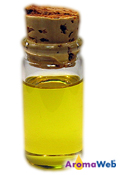
Pale Yellow to Deep Yellow
Consistency
Thin
Perfumery Note

Top
Strength of Initial Aroma
Strong
Aromatic Description
Cold pressed Lemon Essential Oil has a fresh, bright, zesty aroma that more closely mirrors the scent of a freshly peeled lemon than that of steam distilled Lemon Essential Oil. Steam Distilled Lemon Essential Oil tends to have a softer, sweeter, and less sharply "zesty" scent.
Sustainability and Conservation Status
Not Evaluated by the IUCN Red List of Threatened Species
Source: IUCN Red List Search
Last Searched: February 15, 2026
To learn more about the conservation status of essential oil bearing plants and how to use the IUCN Red List of Threatened Species, please refer to AromaWeb's Guide to Essential Oils and Sustainability.
Major Constituents of Cold Pressed Lemon Oil
- (+)-Limonene
- B-Pinene
- Gamma-Terpinene
- a-Terpineol
- a-Pinene
- Geranial
See Essential Oil Safety for more complete list of typical constituents.
Source: B.M. Lawrence, Essential Oils 1988-1991 (Wheaton: Allured Publishing, 1993), 61-69. B.M. Lawrence, Essential Oils 1988-1991 (Wheaton: Allured Publishing, 1995), 1-4, 158-162. B.M. Lawrence, Progress in Essential Oils. (Perfumer & Flavorist 21 no. 1, 1996), 41-45. B.M. Lawrence, Progress in Essential Oils. (Perfumer & Flavorist 27 no. 2, 2002), 62-88. Sources cited in Robert Tisserand and Rodney Young, Essential Oil Safety (Second Edition. United Kingdom: Churchill Livingstone Elsevier, 2014), 331-332.
Major Constituents of Steam Distilled Lemon Oil
- (+)-Limonene
- B-Pinene
- Gamma-Terpinene
- Geranial
- a-Pinene
See Essential Oil Safety for more complete list of typical constituents.
Source: B.M. Lawrence, Essential Oils 1988-1991 (Wheaton: Allured Publishing, 1993), 62. Source cited in Robert Tisserand and Rodney Young, Essential Oil Safety (Second Edition. United Kingdom: Churchill Livingstone Elsevier, 2014), 330-331.
Lemon Essential Oil Safety Information
Cold pressed Lemon Essential Oil is phototoxic. Steam distilled Lemon Oil is not phototoxic. Tisserand and Young recommend a dermal maximum of 2.0% for the cold pressed oil to avoid the risk of a phototoxic reaction. They precaution to avoid topical use of Lemon Oil, regardless of method of distillation, if it has oxidized. Reading Tisserand and Young's full profile is recommended. [Robert Tisserand and Rodney Young, Essential Oil Safety (Second Edition. United Kingdom: Churchill Livingstone Elsevier, 2014), 87, 330-331.]
Lemon Oil may cause skin irritation or sensitivity in some. [Julia Lawless, The Illustrated Encyclopedia of Essential Oils (Rockport, MA: Element Books, 1995), 120.]
Detailed Guide to Lemon-Scented Essential Oils
Not all lemon-scented essential oils are derived from citrus fruits. Instead, they are a diverse group of essential oils that share a refreshing, lemony aroma.
Explore AromaWeb's insightful Lemon-Scented Essential Oil Guide and learn about their composition, uses, benefits, how they differ, safety considerations and more.
General Safety Information
Do not take any oils internally and do not apply undiluted essential oils, absolutes, CO2s or other concentrated essences onto the skin without advanced essential oil knowledge or consultation from a qualified aromatherapy practitioner. For general dilution information, read AromaWeb's Guide to Diluting Essential Oils. If you are pregnant, epileptic, have liver damage, have cancer, or have any other medical problem, use oils only under the proper guidance of a qualified aromatherapy practitioner. Use extreme caution when using oils with children and be sure to first read the recommended dilution ratios for children. Consult a qualified aromatherapy practitioner before using oils with children, the elderly, if you have medical issues or are taking medications. Before using this or any essential oil, carefully read AromaWeb's Essential Oil Safety Information page. For in-depth information on oil safety issues, read Essential Oil Safety by Robert Tisserand and Rodney Young.
Shelf Life
Important Information About the Profiles
The essential oil information provided on AromaWeb is intended for basic educational purposes only. The references to safety information, test results, constituents and percentages is generalized information. Essential oils can vary greatly in composition. The data is not necessarily complete and is not guaranteed to be accurate. The essential oil photos are intended to represent the typical and approximate color of each essential oil. However, essential oil composition and color can vary based on harvesting, distillation, age of the essential oil and other factors. Profiles for several CO2 Extracts and absolutes are included within the directory, and are denoted as such.