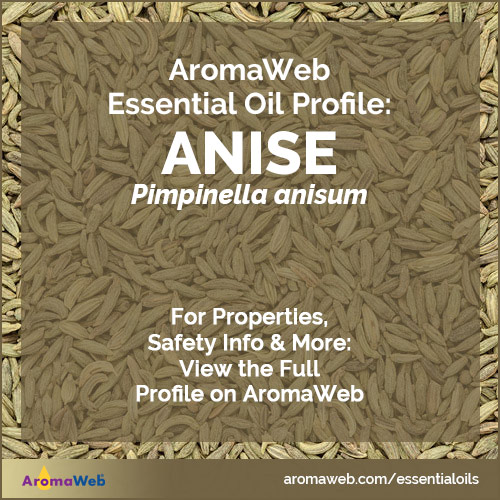
Anise Essential Oil
Pimpinella anisum

Description
Anise Essential Oil is steam distilled from the seeds of the anise plant. It possesses the distinctive aroma of black licorice. Although you may not be a fan of black licorice, a single drop or two of Anise Seed Essential Oil can dramatically enhance an otherwise dull blend.

Anise Essential Oil can be useful in diffuser and inhaler blends intended to help ease bronchitis, colds and the flu. It is said to help promote the production of breast milk and stimulate menstruation, but it should be used with caution and avoided in estrogen-dependent cancers (see safety notes below).
Emotionally, Anise Essential Oil can be calming when used in very small dilutions.
Anise and Star Anise Essential Oils are often grouped together and sometimes are confused with each other as both possess a similar aroma and have similar, but not completely identical properties.
Anise Essential Oil has several safety precautions as noted below.
Anise Essential Oil Benefits and Uses
- Bronchitis
- Colds
- Coughs
- Flatulence
- Flu
- Muscle Aches
- Rheumatism
Source: Julia Lawless, The Encyclopedia of Essential Oils (Updated Edition) (London: Harper Thorsons, 2014), 39.
Botanical Name
Plant Family
Common Method of Extraction
Steam Distilled
Plant Part Typically Used
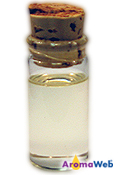
Color
Clear
Consistency
Thin
Perfumery Note
Top
Strength of Initial Aroma
Medium
Aromatic Description
Anise Essential Oil smells similar to that of licorice. It is rich and sweet.
Sustainability and Conservation Status
Not Evaluated by the IUCN Red List of Threatened Species
Source: IUCN Red List Search
Last Searched: February 15, 2026
To learn more about the conservation status of essential oil bearing plants and how to use the IUCN Red List of Threatened Species, please refer to AromaWeb's Guide to Essential Oils and Sustainability.
Major Constituents
- (E)-Anethole
- (+)-Limonene
- Estragole
- Anisyl alcohol
See Essential Oil Safety for a more complete list of constituents.
Source: B.M. Lawrence, Essential Oils 1988-1991 (Wheaton: Allured Publishing, 1995), 199. R. Tabacchi, J. Garnero, R. Bull, Contribution aletude de la composition de l'huile essentialle de fruits d'anise de Turque. (Rivista Italiana EPPOS 56, 1974), 683-697. K.H. Kubeczka, Essential Oils Analysis by Capillary Gas Chromatography and Carbon-13 NMR Spectoroscopy, Second Edition. (Chichester: Wiley, 2002). Sources cited in Robert Tisserand and Rodney Young, Essential Oil Safety (Second Edition. United Kingdom: Churchill Livingstone Elsevier, 2014), 196.
Anise Essential Oil Safety Information
Various precautions abound for those with hypersensitive skin or with skin problems. Tisserand and Young recommend a dermal maximum of 2.4%. They indicate that it may inhibit blood clotting and that it is contraindicated in pregnancy/breastfeeding, endometriosis and estrogen-dependent cancers. Avoid use with children under 5. Avoid use of the oil if it has oxidized. Reading Tisserand and Young's full profile is recommended. [Robert Tisserand and Rodney Young, Essential Oil Safety (Second Edition. United Kingdom: Churchill Livingstone Elsevier, 2014), 196.]
General Safety Information
Do not take any oils internally and do not apply undiluted essential oils, absolutes, CO2s or other concentrated essences onto the skin without advanced essential oil knowledge or consultation from a qualified aromatherapy practitioner. For general dilution information, read AromaWeb's Guide to Diluting Essential Oils. If you are pregnant, epileptic, have liver damage, have cancer, or have any other medical problem, use oils only under the proper guidance of a qualified aromatherapy practitioner. Use extreme caution when using oils with children and be sure to first read the recommended dilution ratios for children. Consult a qualified aromatherapy practitioner before using oils with children, the elderly, if you have medical issues or are taking medications. Before using this or any essential oil, carefully read AromaWeb's Essential Oil Safety Information page. For in-depth information on oil safety issues, read Essential Oil Safety by Robert Tisserand and Rodney Young.
Shelf Life
Important Information About the Profiles
The essential oil information provided on AromaWeb is intended for basic educational purposes only. The references to safety information, test results, constituents and percentages is generalized information. Essential oils can vary greatly in composition. The data is not necessarily complete and is not guaranteed to be accurate. The essential oil photos are intended to represent the typical and approximate color of each essential oil. However, essential oil composition and color can vary based on harvesting, distillation, age of the essential oil and other factors. Profiles for several CO2 Extracts and absolutes are included within the directory, and are denoted as such.