Patchouli Essential Oil
Pogostemon cablin
Description
Patchouli Essential Oil has many uses and offers numerous benefits, despite its aroma being an "acquired taste" (so to speak) for some. I use Patchouli Oil in skin care applications, emotionally in diffuser blends, romantically in sensual blends, spiritually at times for meditation, and in making natural personal fragrances. Try using it in low dilution and blend it with other essential oils if you find the aroma a bit overpowering or too earthy to use alone. Patchouli shines beautifully when used in synergy with other essential oils.
Unlike most essential oils that oxidize and diminish in therapeutic and aromatic quality over time, the aroma of Patchouli Essential Oil improves with age like a fine wine.
The fragrance of Patchouli Essential Oil is rich, earthy and grounding. In perfumery and fragrancing applications, patchouli is a base note that acts as a fixative and grounds a blend. Its aroma is suitable for unisex and men's blends. It can act as an aphrodisiac. Patchouli is often associated with the hippies and the 1960s. Some individuals, therefore, hold a negative connotation of the oil, but I recommend that you keep an open mind when assessing and working with the oil. Especially in small ratios, Patchouli Oil is such a beautiful, rich, sultry oil to work with.

In skin and hair care, Patchouli Oil is a wonderful staple to keep on hand. It is helpful for most all skin types ranging from dry, cracked skin all the way to helping to regulate oily skin and acne. Those with eczema, psoriasis and dandruff have said that patchouli is especially helpful for them. Emotionally, Patchouli Essential Oil is calming and grounding. Spiritually, it has been used alone or in blends during prayer and meditation.
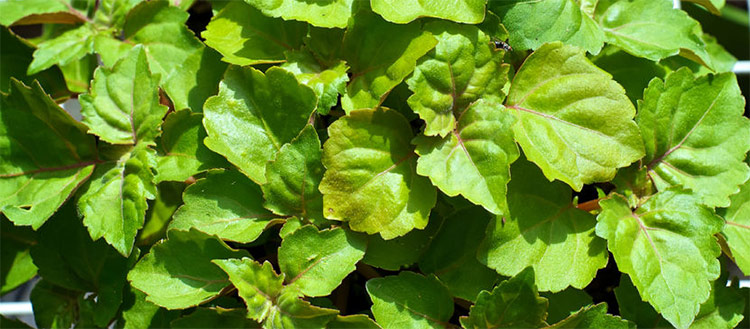
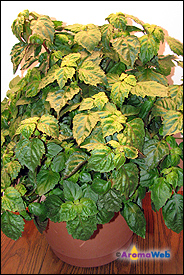
Patchouli thrives in tropical regions and can be found in Hawaii, regions of Asia and other tropical areas of the world. Patchouli is not native to where I reside in Michigan, but I have enjoyed growing it during the summer months for the past few years.
The Difference Between Light and Dark Patchouli Essential Oil
Traditionally, Patchouli Oil is distilled using iron stills. This leads to a darker and aromatically deeper oil. This oil sometimes is known as "Dark Patchouli Oil."
Patchouli is sometimes distilled using stainless steel stills, and the resulting oil is sometimes known as "Light Patchouli Oil" because it is lighter in color and aroma.
Not all Patchouli Oils, however, are designated as "light " or "dark " by suppliers. I have also seen some suppliers refer to Patchouli Oil as being light or dark due to its aroma or color characteristics and not due to the type of still that was used for distillation.
Patchouli Essential Oil Benefits and Uses
- Acne
- Athlete's Foot
- Chapped Skin
- Dermatitis
- Eczema
- Fatigue
- Frigidity
- Hair Care
- Insect Repellent
- Mature Skin
- Oily Skin
- Stress
Source: Julia Lawless, The Encyclopedia of Essential Oils (Updated Edition) (London: Harper Thorsons, 2014), 160-161.
Botanical Name
Plant Family
Common Method of Extraction
Steam Distilled
Plant Part Typically Used
Color
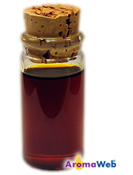
Deep Golden Brown
Consistency
Medium - Thick
Perfumery Note
Base
Strength of Initial Aroma
Medium
Aromatic Description
Patchouli Essential Oil smells deep, earthy and woody.
Sustainability and Conservation Status
Not Evaluated by the IUCN Red List of Threatened Species
Source: IUCN Red List Search
Last Searched: February 15, 2026
To learn more about the conservation status of essential oil bearing plants and how to use the IUCN Red List of Threatened Species, please refer to AromaWeb's Guide to Essential Oils and Sustainability.
Major Constituents of Indonesian Patchouli Oil
- Patchouli Alcohol
- a-Bulnesene
- a-Guaiene
- Seychellen
- Gamma-Patchoulene
- a-Patchoulene
See Essential Oil Safety for more complete list of typical constituents.
Source: K. Bruns, Ein Beitrag zur Untersuchung und Qualitatsbewertung von Patchouliol. (Parfumerie Kosmetik 59, 1978), 109-115. B.M. Lawrence, Essential Oils 1981-1987 (Wheaton: Allured Publishing, 1989), 15. B.M. Lawrence, Essential Oils 1988-1991 (Wheaton: Allured Publishing, 1993), 91.M.J. Milchard, R. Clery, N. DaCosta, et al. Application of Gas-Liquid Chromatography to the Analysis of Essential Oils. (Perfumer & Flavorist 29, 2004), 28-36. Sources cited in Robert Tisserand and Rodney Young, Essential Oil Safety (Second Edition. United Kingdom: Churchill Livingstone Elsevier, 2014), 382.
Patchouli Essential Oil Safety Information
Tisserand and Young indicate that Patchouli Oil may inhibit blood clotting and pose a drug interaction hazard. Reading Tisserand and Young's full profile is recommended. [Robert Tisserand and Rodney Young, Essential Oil Safety (Second Edition. United Kingdom: Churchill Livingstone Elsevier, 2014), 382.]
General Safety Information
Do not take any oils internally and do not apply undiluted essential oils, absolutes, CO2s or other concentrated essences onto the skin without advanced essential oil knowledge or consultation from a qualified aromatherapy practitioner. For general dilution information, read AromaWeb's Guide to Diluting Essential Oils. If you are pregnant, epileptic, have liver damage, have cancer, or have any other medical problem, use oils only under the proper guidance of a qualified aromatherapy practitioner. Use extreme caution when using oils with children and be sure to first read the recommended dilution ratios for children. Consult a qualified aromatherapy practitioner before using oils with children, the elderly, if you have medical issues or are taking medications. Before using this or any essential oil, carefully read AromaWeb's Essential Oil Safety Information page. For in-depth information on oil safety issues, read Essential Oil Safety by Robert Tisserand and Rodney Young.
Shelf Life
Important Information About the Profiles
The essential oil information provided on AromaWeb is intended for basic educational purposes only. The references to safety information, test results, constituents and percentages is generalized information. Essential oils can vary greatly in composition. The data is not necessarily complete and is not guaranteed to be accurate. The essential oil photos are intended to represent the typical and approximate color of each essential oil. However, essential oil composition and color can vary based on harvesting, distillation, age of the essential oil and other factors. Profiles for several CO2 Extracts and absolutes are included within the directory, and are denoted as such.